martes, 12 de agosto de 2025

EP.73 WHO LET THE DOGS OUT, NEW QUADRUPEDS


Forwarded this email? Subscribe here for more

EP.73 WHO LET THE DOGS OUT, NEW QUADRUPEDS

Robotic microfactories to rebuild homes, a new 'care-bot' from Fourier & much more...


READ IN APP
 

New quadruped from Unitree with dual LiDAR! 🦮

Unitree Robotics has introduced the A2, its most advanced quadruped robot to date, just one week after unveiling its $5,900 R1 humanoid. Designed for industrial inspection, logistics, and research applications, the A2 balances endurance, strength, speed, and perception in a compact, versatile platform.

The Hangzhou-based robotics firm has equipped the A2 with dual industrial lidar sensors—one front, one rear—alongside an HD camera and integrated front light to deliver full 360° environmental awareness and eliminate blind spots. This marks a notable perception upgrade over its predecessor, the B2, which featured a single lidar and depth camera.

Weighing 37 kg (81.5 lb.) unloaded, the A2 can carry payloads of up to 25 kg (55 lb.) while walking for three hours or covering 12.5 km (7.7 mi.) on a single charge. Hot-swappable dual batteries allow for uninterrupted missions, whether in field inspections or warehouse operations.

The A2 is available with standard legs or wheeled-leg configurations, giving operators flexibility in terrain handling and mobility. The launch comes on the heels of Unitree’s recent Series C funding round, which valued the company at approximately $1.7 billion.

Check out here!


Robotic microfactories rebuild fire-damaged homes! 🧯

In the wake of the devastating 2025 Southern California wildfires, ABB Robotics and Cosmic Buildings are teaming up to deploy AI-powered robotic microfactories that can construct modular homes directly on-site. The first deployment in Pacific Palisades aims to deliver 100 fire-resistant, net-zero homes by 2027, cutting build times by up to 70% and costs by 30% compared to traditional methods.

The approach integrates ABB’s IRB 6710 industrial robots and RobotStudio® digital twin software with Cosmic’s AI-driven Building Information Model (BIM) and mobile Robotic Workstation Cells. This setup enables millimeter-precision fabrication of custom wall panels, which are assembled just in time at the construction site. The homes use non-combustible materials, solar and battery systems, and advanced water independence features—exceeding California’s wildfire and energy efficiency codes.

By combining robotic automation, AI decision-making, and on-location manufacturing, the microfactory can complete a home in as little as 12 weeks at $550–$700 per square foot, significantly under Los Angeles’ $800–$1,000 average. The process also minimizes waste and eases the rebuilding burden for underinsured homeowners.

Read the whole story here!

🦾 Feature sponsorship with ABB Robotics

Fourier unveils a ‘care-bot’ with emotional intelligence ❤️‍🔥

Fourier has introduced the GR-3, its first full-size humanoid in the GRx series, designed to bring empathy-driven robotics into homes, hospitals, and public spaces. Branded as a “Care-bot,” GR-3 combines task efficiency with emotional rapport, leveraging the company’s Full-Perception Multimodal Interaction System to integrate vision, audio, and tactile feedback into a real-time emotional processing engine.

Standing 165 cm tall and weighing 71 kg, GR-3 offers 55 degrees of freedom for natural movement, animated facial expressions, and soft-touch materials to create a familiar, approachable presence. It uses a four-microphone array for voice localization, structured-light cameras for facial recognition, and 31 pressure sensors to trigger lifelike touch responses—such as blinking or shifting gaze.

A dual-path architecture powers its cognition: “fast thinking” for reflexive responses and “slow thinking” for context-rich dialogue, allowing it to adapt to both tasks and emotional cues. Locomotion modes range from standard walking to expressive gaits like “bouncy walk” or “fatigue mode,” enhancing human-like interaction.

With hot-swappable batteries, developer-friendly APIs, and modular hardware, GR-3 is positioned as both a deployable service robot and a flexible research platform. Fourier’s goal is to create machines that are not just functional in human environments, but genuinely accepted within them.

Read more here!


Meme of the week 🤖

Labor shortage, you say?


No alt text provided for this image

New humanoid, Oli from LimX Dynamics! 🆕

Chinese robotics company LimX Dynamics has introduced Oli, its most advanced humanoid to date—a full-sized, general-purpose robot designed to support everything from AI research and warehouse automation to gym workouts and kung fu demonstrations.

Available in Lite, EDU, and Super configurations, Oli starts at approximately $21,800 and ships with a modular hardware-software architecture. Its standout feature: a fully interchangeable arm system that supports a range of end-effectors—from standard hands to precision grippers and agile robotic manipulators. This flexibility positions Oli as a development platform as much as a robot, enabling researchers and integrators to prototype and deploy across vastly different domains.

At 1.65 meters tall with 31 degrees of freedom, Oli combines mobility, balance, and real-time adaptability—traits essential for navigating human environments. The robot’s open SDK gives users low-level access to joint actuation and sensor data, as well as high-level task scheduling, supporting advanced development in reinforcement learning and embodied AI.

To promote accessibility, LimX is running a limited buy-one-get-one deal for its EDU version, bundling in a free TRON 1 EDU bipedal robot for early buyers. The company aims to make reinforcement learning tools more available to labs and startups pursuing next-gen robotics.

Read more here!


EngineAI presents next-gen humanoids and quadrupeds!

Shenzhen-based EngineAI unveiled a lineup of advanced robotic platforms at the World Robot Conference 2025 in Beijing. The spotlight was on PM01, EngineAI’s agile humanoid capable of lifelike movements, autonomous fall recovery, and seamless navigation through complex environments. Its ability to perform precise sitting and resting motions, combined with a more fluid, human-like gait and high-speed running, demonstrated the platform’s versatility for real-world applications.

Making its global debut, the T800 heavy-duty humanoid stole attention with industrial-grade capabilities. Standing 1.85 meters tall and weighing 85 kg, it features 41 high-degree-of-freedom joints, a solid-state battery, and an aluminum alloy exoskeleton for heavy-load operations. A multi-sensor fusion system enables rapid environmental perception and decision-making, delivering both endurance and precision in demanding industrial environments.

EngineAI also previewed SA02, an entry-level humanoid designed for young engineers and hobbyists. Priced from $5,300, it aims to make advanced robotics more accessible to the next generation.

Expanding beyond humanoids, the company introduced the JS01 quadruped—a high-mobility, bionic-inspired platform equipped with adaptive shock-absorbing joints, LiDAR, and depth cameras.

Read more here!


we all are robots is a reader-supported publication. To support my work, consider becoming a free or paid subscriber.

I want the newsletter to be accessible to everyone, regardless of background, social status, or education.

Everyone should have access to the latest information and education.

That is why my newsletter is free. If you want to support the operation of the newsletter, I would appreciate a voluntary donation!


viernes, 8 de agosto de 2025

Investigadores descubren que la experiencia sensorial influye sobre la forma que adquieren las neuronas

eferemail shared this article with you from Inoreader
via Minadatos
El investigador Víctor Borrell, del Instituto de Neurociencias de Alicante, centro mixto del Consejo Superior de Investigaciones Científicas (CSIC) y la Universidad Miguel Hernández, ha puesto de manifiesto el mecanismo celular que controla el desarrollo y la diferenciación de las neuronas estrelladas de la capa 4 de la corteza cerebral.

Los resultados de esta investigación, obtenidos en colaboración con el investigador Edward M. Callaway, del Salk Institute for Biological Studies de California, demuestran que la percepción sensorial desempeña un papel fundamental en el proceso de desarrollo del cerebro, ya que determina la forma que van a tener muchas de las neuronas de la corteza cerebral.

Este descubrimiento ha sido publicado en la prestigiosa revista 'The Journal of Neuroscience' y supone un "avance significativo" a la hora de comprender los mecanismos implicados en el desarrollo de la corteza cerebral, según ha informado el CSIC e un comunicado.

Los resultados obtenidos en la investigación muestran los mecanismos celulares implicados en la adquisición de las distintas morfologías de las neuronas de la corteza cerebral y ponen de manifiesto, por primera, vez la participación activa de la experiencia sensorial en este proceso, paso clave para el correcto funcionamiento del cerebro.

El investigador Víctor Borrell ha explicado que "para la mayoría de neuronas de la corteza cerebral, el proceso de desarrollo es relativamente sencillo: crecer y aumentar en complejidad". Sin embargo, "en el caso de las neuronas estrelladas el proceso es distinto, y consta de dos fases completamente contrapuestas".

En una primera fase estas neuronas aumentan en tamaño y complejidad, adquiriendo una morfología similar a las típicas neuronas piramidales. En una segunda fase, estas neuronas entran en un proceso de regresión, durante el cual sufren una reducción del tamaño y de la complejidad de su dendrita principal, alcanzando finalmente la típica forma estrellada.

Este tipo de desarrollo únicamente había sido observado en una pequeña población muy particular de neuronas de la corteza, pero este estudio demuestra que lo mismo sucede en la mayoría de neuronas de la capa 4, según ha destacado el investigador.

LA REGIÓN MÁS COMPLEJA DEL CEREBRO

La corteza cerebral es la región más compleja del cerebro de los mamíferos y la parte más desarrollada en el cerebro de los seres humanos. "La información que recibimos del mundo exterior a través de nuestros sentidos viaja por el sistema nervioso hasta la corteza cerebral, donde esta información es procesada, integrada, y combinada con recuerdos y sensaciones anteriores, dando lugar a nuestra particular percepción del mundo que nos rodea", ha señalado Borrell.

La corteza cerebral contiene un repertorio único de tipos de neuronas, que se distinguen por tener cada uno su forma característica, definida por la extensión y arborización de sus dendritas. La mayor parte de las neuronas excitadoras de la corteza cerebral se caracterizan por tener una dendrita apical larga que predomina sobre varias dendritas basales más cortas, dando a estas neuronas un aspecto piramidal. En la capa 4, sin embargo, predomina un tipo de neurona con una dendrita apical corta similar a las dendritas basales, dando a estas neuronas un aspecto muy característico de asterisco o estrella.

Diversos estudios habían demostrado que durante el desarrollo de la corteza cerebral las neuronas piramidales sufren un notable crecimiento y arborización de todas sus dendritas, lo que finalmente acaba dando lugar a la forma piramidal típica de estas neuronas en el cerebro adulto.

También se ha propuesto que el tamaño y la forma finales de estas neuronas piramidales son fruto de la combinación de factores genéticos intrínsecos, e influencias ambientales locales, incluyendo la actividad eléctrica de las propias neuronas.

Al contrario que con las neuronas piramidales, los mecanismos encargados de dirigir el desarrollo de las dendritas hacia una forma estrellada, como ocurre con las neuronas de la capa 4 de la corteza cerebral, y los factores que influyen sobre este proceso eran enteramente desconocidos, hasta ahora.

Una vez comprendido el proceso mediante el cual las neuronas estrelladas adquieren su forma definitiva en dos fases, los investigadores Víctor Borrell y Edward Callaway comenzaron la búsqueda de los factores que regulan este proceso.

Descubrieron que la actividad sensorial parece tener una importancia capital en ese proceso. Vieron que en situaciones de deprivación visual, donde la corteza cerebral no recibe impulsos eléctricos procedentes de la retina, las neuronas de la capa 4 solo completaban con éxito la primera fase de su desarrollo, la de crecimiento y aumento de complejidad.

Sin embargo, llegado el momento de empezar la segunda fase de desarrollo, la de retracción de la dendrita apical, la mayoría de neuronas era incapaz de hacer ese cambio y permanecía en fase de crecimiento, conservando la forma piramidal. Por lo tanto, la percepción sensorial, y en este caso la percepción visual, desempeña un papel fundamental en el proceso de desarrollo del cerebro, ya que determina la forma que van a tener muchas de las neuronas de la corteza cerebral.
View on Web

martes, 31 de diciembre de 2024

Fwd: EP.10 ROBOTS ARE TRANSFORMING THE FARMING INDUSTRY


Swarm of tiny, self-driving robots, underwater two-arm robot, cobots help to identify the gender of chickens and much more...  ‌ ‌ ‌ ‌ ‌ ‌ ‌ ‌ ‌ ‌ ‌ ‌ ‌ ‌ ‌ ‌ ‌ ‌ ‌ ‌ ‌ ‌ ‌ ‌ ‌ ‌ ‌ ‌ ‌ ‌ ‌ ‌ ‌ ‌ ‌ ‌ ‌ ‌ ‌ ‌ ‌ ‌ ‌ ‌ ‌ ‌ ‌ ‌ ‌ ‌ ‌ ‌ ‌ ‌ ‌ ‌ ‌ ‌ ‌ ‌ ‌ ‌ ‌ ‌ ‌ ‌ ‌ ‌ ‌ ‌ ‌ ‌ ‌ ‌ ‌ ‌ ‌ ‌ ‌ ‌ ‌ ‌ ‌ ‌ ‌ ‌ ‌ ‌ ‌ ‌ ‌ ‌ ‌ ‌ ‌ ‌ ‌ ‌ ‌ ‌ ‌ ‌ ‌ ‌ ‌ ‌ ‌ ‌ ‌ ‌ ‌ ‌ ‌ ‌ ‌ ‌ ‌ ‌ ‌ ‌ ‌ ‌ ‌ ‌ ‌ ‌ ‌ ‌ ‌ ‌ ‌ ‌ ‌ ‌ ‌ ‌ ‌ ‌ ‌ ‌ ‌ ‌ ‌ ‌ ‌ ‌ ‌ ‌ ‌ ‌ ‌ ‌ ‌ ‌ ‌ ‌ ‌ ‌ ‌ ‌ ‌ ‌ ‌ ‌ ‌ ‌ ‌ ‌ ‌ ‌ ‌ ‌ ‌ ‌ ‌ ‌ ‌ ‌ ‌ ‌ ‌ ‌ ‌ ‌ ‌ ‌ ‌ ‌ ‌ ‌ ‌ ‌ ‌ ‌ ‌ ‌ ‌ ‌ ‌ ‌
Open in app or online

EP.10 ROBOTS ARE TRANSFORMING THE FARMING INDUSTRY

Swarm of tiny, self-driving robots, underwater two-arm robot, cobots help to identify the gender of chickens and much more...

May 9
 
Share
 

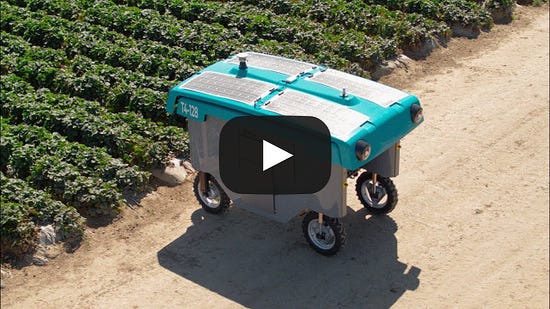
Farming revolution 🚜 (90 seconds VIDEO that will explain it to you!)

What if you could use a swarm of tiny, self-driving robots to tend to every plant individually, instead of relying on large tractors that require a human operator? That's the idea behind autonomous farming, and it could revolutionize the industry.

According to Dr. Richard Franklin, a robotics expert at Harper Adams University in the UK, small robots are inherently safer and more efficient than large tractors. By using swarms of tiny machines, farmers can achieve greater precision with fertilizers and pesticides, reduce soil compaction, and cover larger areas of land.

As the world's population continues to grow, we'll need to produce more food in less space. Autonomous farming could be the key to meeting this challenge, as it offers increased efficiency, reduced labor costs, and more sustainable farming practices.

The job of heavy machinery operators will evolve into overseeing agricultural automation using autonomous machines. By incorporating this technology into farming, we can create a safer, more efficient, and more sustainable food system for generations to come.


Sorting the garbage using robots! 🗑️♻️

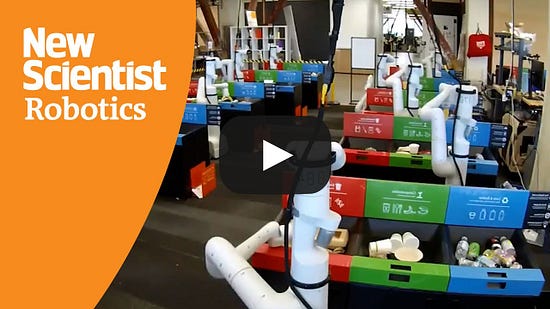
Robots have come a long way from being just machines with the ability to move. With advancements in computer vision, artificial intelligence, and integration with external systems, they have become powerful tools for automating not only repetitive tasks but also complex processes.

A recent research study has demonstrated that robots can learn how to recycle, using AI to sort and categorize waste. The study shows that tasks that were previously out of reach for robotics are now becoming a reality, with robots potentially being used to help address the pressing issue of waste management and recycling.

The numbers speak for themselves: humanity generates about 350 million tonnes of waste every year, and we are notoriously bad at sorting it properly, with less than 10% of it going back to recycling. This is where robots can potentially help, using their ability to learn and adapt to better sort and process waste.

Combining robotics with AI and machine learning solutions can help improve the recycling score and bring us one step closer to a more sustainable future. With the technology already showing promise in research studies, it won't be long before we see the first commercially available recycling robots.


Exploring the underwater world 🌊

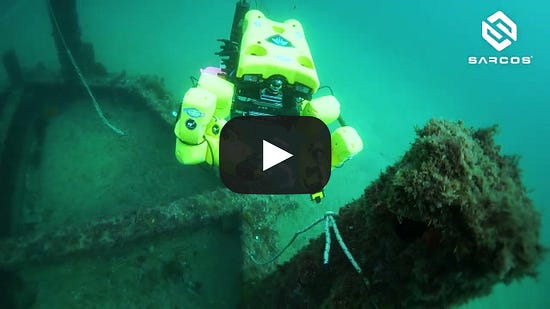
Exploring the depths of the ocean is an exciting yet challenging task, with the need for sophisticated technology to aid in underwater research. The Sarcos Remotely-Operated-Vehicle (ROV) - Guardian boasts exceptional dexterity, making it ideal for light-work missions and reducing the need to put divers into the water. With 12 degrees of freedom (DoF), the robot can grasp objects with precision and ease, providing a level of accuracy that was once impossible.

What sets the Sarcos ROV apart from other underwater robots is its unique design. The system is electronically driven, eliminating the need for heavy hydraulic power unit systems. This makes it possible for the robot to be teleoperated via supervised autonomy, reducing the size, weight, and expense of the device.

With the Guardian, underwater inspection is possible at depths of up to 1,000 meters. The robot can operate in different modes, including remote teleoperation and supervised autonomy, making it adaptable to different underwater environments.

The Sarcos ROV (Guardian) is a game-changer for underwater exploration and research, providing scientists and researchers with a sophisticated tool to aid in their work. With its advanced technology and exceptional capabilities, Sarcos Robotics is paving the way for the future of underwater robotics.


How do robots determine the gender of chickens? 🐣

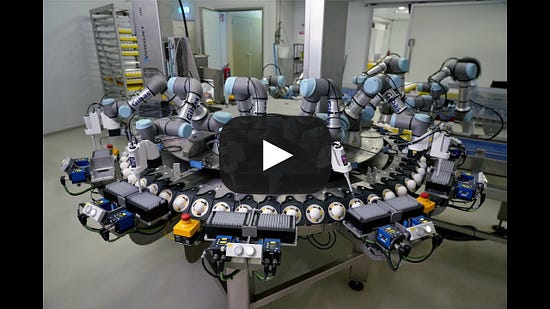
When we think of cobots, we often imagine them working side by side with human workers in manufacturing plants. But cobots have a wide range of applications, including in the agriculture industry. One of the most fascinating examples of this is the gender determination process used by the Respeggt Group.

Respeggt is a company that specializes in the production of eggs that don't require the culling of male chicks. In order to do this, they use an application that involves extracting allantoic fluid from eggs using non-invasive suction. The fluid is then analyzed to determine the gender of the chick inside the egg. This method is much more humane than traditional methods, which involve culling male chicks shortly after they hatch.

But what's most impressive about this process is the absolute synchronization of the robots involved. The cobots work together seamlessly to perform a variety of activities, including handling the eggs, extracting the fluid, and analyzing the results. This level of cooperation and synchronization is a testament to the power of cobots in industrial applications.

By using cobots in this way, Respeggt is able to produce eggs that are more ethical and sustainable. And as the technology continues to improve, we can expect to see even more innovative applications of cobots in the agriculture industry and beyond.


Join the talent collective!


Robotics Application Of The Week

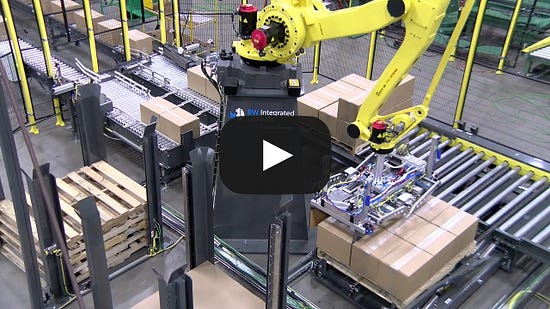
Robotic Palletizing 📦

Palletizing is a process in manufacturing and warehousing that involves stacking and arranging products onto pallets for efficient transport and storage. This process is typically performed by industrial robots, which use advanced software and sensors to automate the stacking and arranging of products onto pallets.

Types of palletizing that can be performed by robots include:

  1. Layer palletizing - In this method, robots can place complete layers of products on the pallet. It can handle different products at the same time by picking them from different locations.

  2. Case palletizing - In this method, robots can pick and place individual products onto a pallet to create a specific pattern or arrangement. This is ideal for products that are difficult to arrange in layers or for custom packaging requirements.

  3. Mixed palletizing - In this method, robots can pick and place different products to create a mixed pallet. This can be done based on predetermined configurations or in real-time as products are received.

Overall, palletizing with robots is a highly efficient and cost-effective solution for industries that require the handling of large volumes of products. By using advanced software and sensors, robots can automate the palletizing process and ensure consistent quality and accuracy, while also reducing labor costs and increasing productivity.


Like
Comment
Restack
 

© 2023 Lukas Ziegler
Residence on planet Earth