sábado, 14 de octubre de 2017

The Structure of Electric Power Systems (Generation, Distribution and Transmission Of Energy)

eferemail
shared this article with you from Inoreader
electric-power-systems-structure-728x380
From a general perspective, an electric power system is usually understood as a very large network that links power plants (large or small) to loads, by means of an electric... Read more
View on the web
Inoreader is a light and fast RSS Reader. Follow us on Twitter and Facebook.

The BecDot is an Arduino-based Braille teaching tool for children

eferemail
shared this article with you from Inoreader

While instruments are available for those with visual impairment to read electronic media, they can be quite expensive, costing over $1,000. This is good for adults, but something more kid-friendly (and possibly replaceable) is needed to open up this world to those just learning.

For this purpose, Jacob Lacourse, whose daughter Rebecca was born with Usher Syndrome, developed the BecDot educational toy.

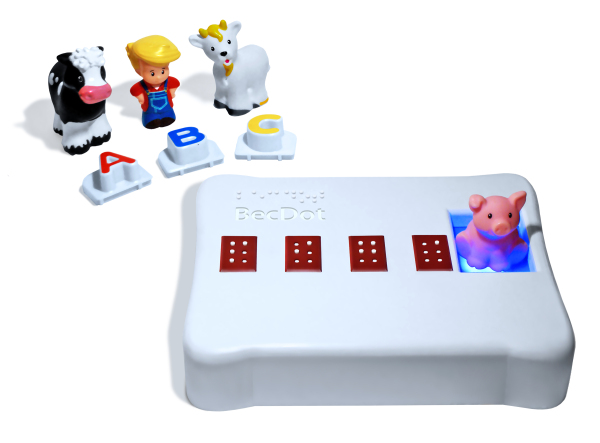
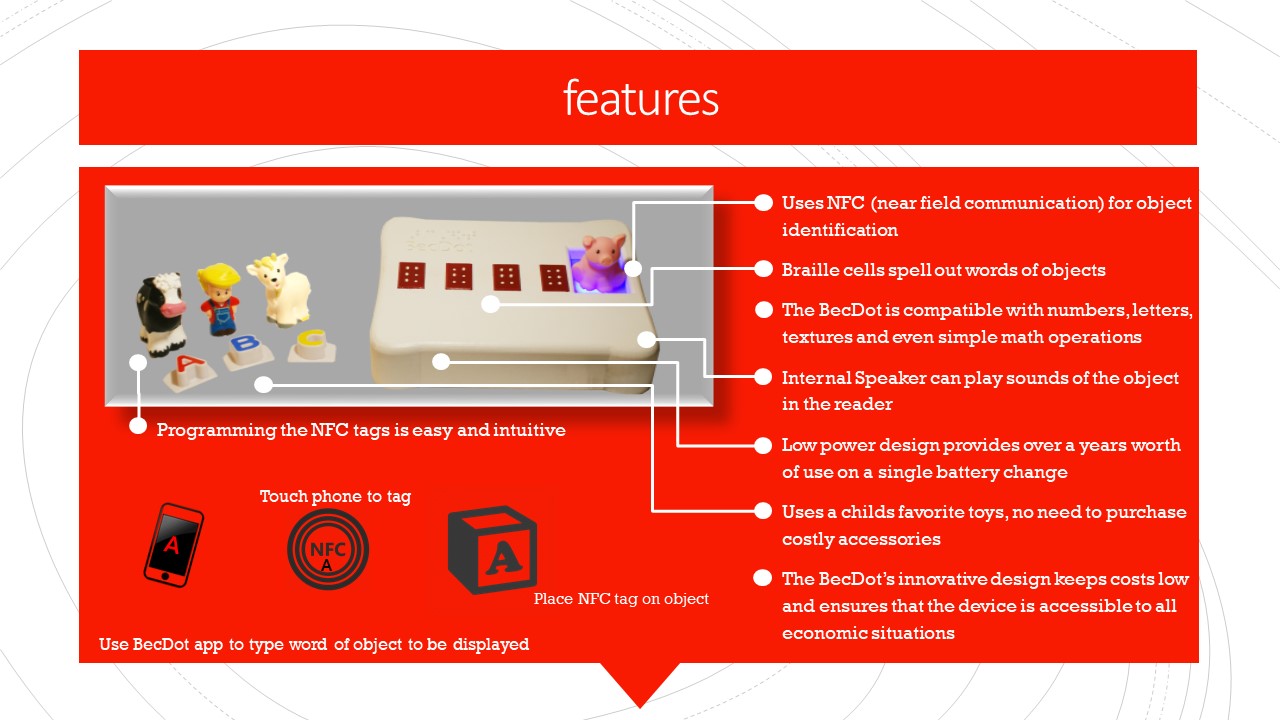
The device–which is now in a prototype form–senses when a plastic object (a letter block, a plastic animal, etc.) is placed in the reader via preprogrammed NFC tags, then raises the corresponding dots on four Braille pads. The prototype uses an Arduino Uno for control, and a system that he developed to raise the Braille dots as needed.

I incorporated an NFC reader (Adafruit PN532) into the device.  The idea was that the reader would read a preprogrammed tag that a parent, caregiver or educator could place on a toy such as a letter block, a plastic dog, cow, goat, etc. When the child places the toy in the reader the device will display the braille equivalent of the object on the four cells.  Of course lights and sounds would also come later in the development of the device.

Lacourse hopes to one day bring the BecDot to market for under $100. Until then, you can check it out in the video below and read more about this amazing project here!

View on the web
Inoreader is a light and fast RSS Reader. Follow us on Twitter and Facebook.

Arduino announces Arm partnership

eferemail
shared this article with you from Inoreader

Dear Arduino Community,

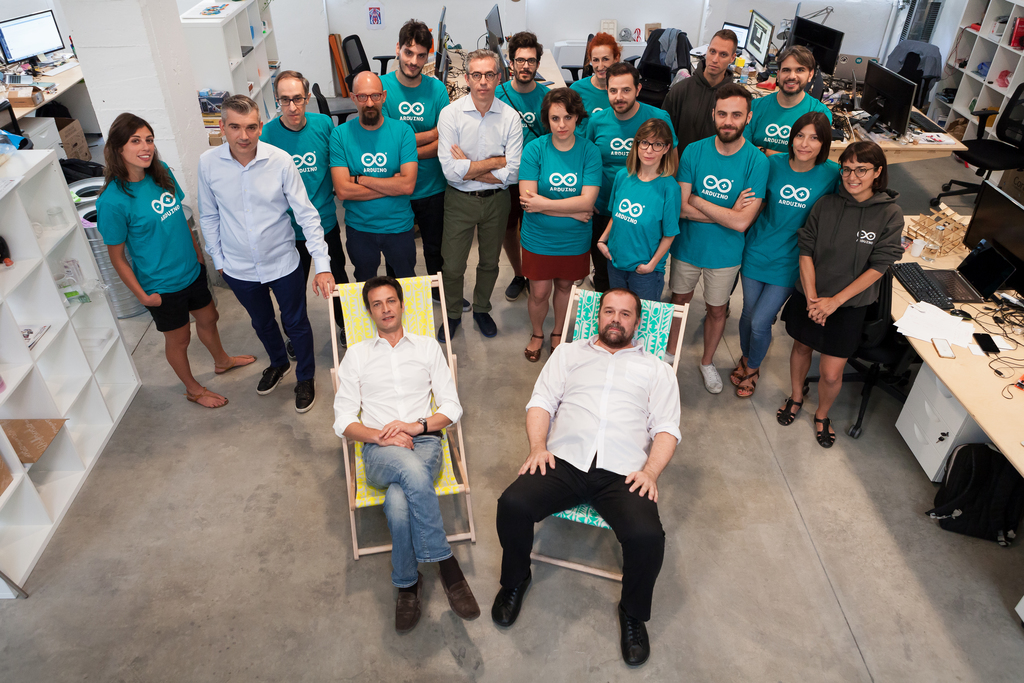
Back in July, we announced that the original Arduino founders regained full control of Arduino as a company. It was the culmination of a project that lasted several months, which required a tremendous amount of effort in finding the right partner that could help us make it happen while keeping the spirit of Arduino true to itself.

Throughout the litigation we dreamed of reclaiming control of the company, bringing it back to its original principles while designing a strategy that would allow us to tackle the challenges of the contemporary IoT world.

In order to make this a reality, we needed a partner that would provide us with the resources to regain full ownership of Arduino as a company while keeping it independent and true to its values of openness.

It wasn't easy, but more than a year ago, in the middle of the litigation, we started a conversation with an important technology company that is an essential building block of today's digital world: Arm.

During a very hot day in spring I visited California to meet with Arm. It was a great meeting of minds and we determined that such a partnership was the right fit for us. Arm is an extremely innovative company whose processors can be found inside virtually every mobile device on the planet; but they don't actually build silicon. Instead, they have created an ecosystem of a thousand-plus partners, some of whom compete with each other, but Arm works in harmony with all of them.

Arm recognized independence as a core value of Arduino. This was very important for us, as it meant full understanding of our need to work with multiple silicon vendors and architectures as long as they make sense for Arduino—without any lock-in with the Arm architecture.

Following the meeting with Arm, I was thrilled. I shared my excitement with our new CEO Fabio Violante and my cofounders: Arduino could again be 100% ours, with the help of a supportive partner that leaves complete autonomy to our team and our community.

We worked very hard for many months to make this happen, and Arm graciously agreed to support us to complete the operation.

What should you expect from us in the future? A stronger Arduino, free to innovate with more firepower, and plenty of enthusiasm for future challenges and opportunities.

We will continue to work with all technology vendors and architectures moving forward. We stay independent; we stay open, and we still provide the most loved microcontroller development platform that has changed the lives of so many people around the world.

View on the web
Inoreader is a light and fast RSS Reader. Follow us on Twitter and Facebook.

Ad Inifitum Machine Uses You!

eferemail
shared this article with you from Inoreader

As seen here, Ad Inifitum is a machine that turns the idea of using it on its head, and instead "lives" by harvesting energy from its human host. This terrifying art installation — developed at the Hasso Plattner Institute in Potsdam, Germany — clamps a humans' arm in place if someone chooses to insert it into one of two arm holes, and causes him or her to rotate a crank using electrical impulses.

Ad infinitum is a parasitical entity which lives off human energy. (📷: Arthur Silber / a-parasite.org)

If the human obediently starts rotating the crank without stimulation, the small shocks stop. The clamps, however, remain closed — hopefully not too tightly — un til the now-enslaved human convinces someone to place a hand in a mirrored setup at the other end of the contraption.

The setup, seen below, is a frightening, if fascinating apparatus. Perhaps it's meant to entice engineers to place a hand inside to investigate. In the middle of its long acrylic shell is a covered box that controls everything, containing an Arduino Mega, as well as an openEMSstim controller to "convince" humans to transfer their energy to the machine.

The device, which made its debut at the Natural History Museum in Bern, Switzerland is meant to illustrate that as we use computers through social media and the like, it can be difficult to see who or what is using who… Maybe it could also serve as a lesson not to stick your hand into an unknown piece of machinery!

stat?event=post.clientViewed&referrerSou

Ad Inifitum Machine Uses You! was originally published in Hackster's Blog on Medium, where peop le are continuing the conversation by highlighting and responding to this story.

View on the web
Inoreader is a light and fast RSS Reader. Follow us on Twitter and Facebook.

Introducing Two New Boards from Arduino

eferemail
shared this article with you from Inoreader

The Arduino MKR WAN 1300 with onboard LoRa, and the MKR GSM 1400 with global 2G/3G capability.

After the resolution of the protracted legal battles around the Arduino trademark there have been a lot of people waiting to see what the new hardware might be on show at Maker Faire New York over the weekend.

Enter the Arduino MKR WAN 1300 and the MKR GSM 1400.

Arduino MKR WAN 1300 (top) and Arduino MKR GSM 1400 (bottom) seen at Maker Faire New York this weekend.

The MKR WAN 1300 is based around the Microchip SAM D21 micro-controller, which integrates an ARM Cortex-M0+ processor, 256KB Flash memory and 32KB SRAM, and the MuRata CMWZIZZABZ low-power LoRa module. Other features include an operating voltage of 3.3V; 8 digital I/Os; 12 PWM outputs; and UART, SPI and I2C interfaces.

The MKR GSM 1400 is based around the same SAM D21 micro-controller, but with a ublox SARA-U201 HSPA/GSM module which can operate at 800, 850, 900, 1900, 2100 MHz for global 2G and 3G coverage. I've been reliably informed that the new board "works just fine" with the new free Hologram.io developer SIM.

Both boards share the same 67.64 × 25mm form factor as the original M KR1000, and the MKR ZERO and MKR FOX 1200 boards. The board's design includes the ability to be powered by either two 1.5V AA or AAA batteries or an external 5V input via the USB interface — with automatic switching between the two power sources.

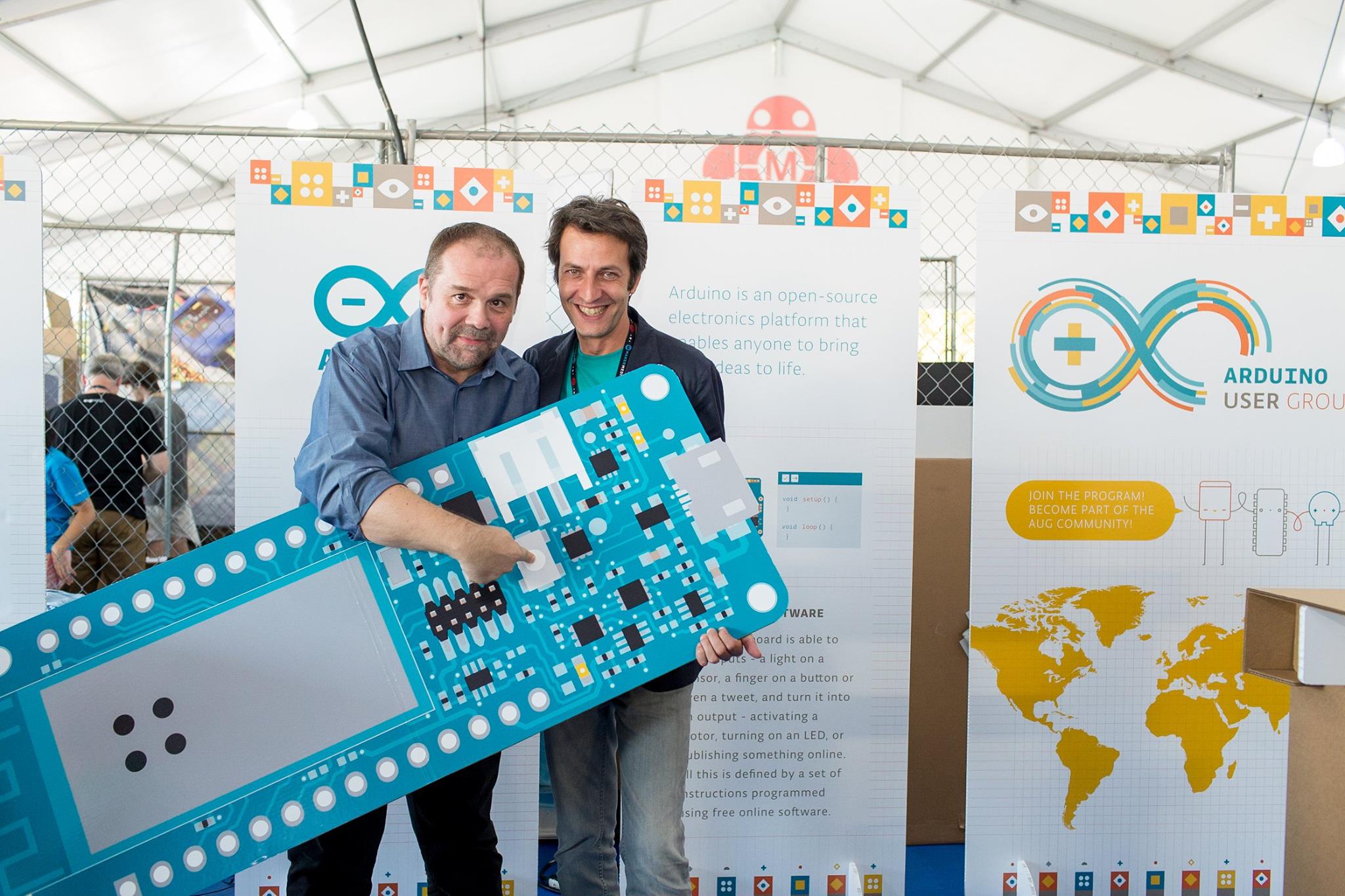
The two boards were announced during Massimo Banzi's "State of Arduino" talk at Maker Faire New York on Saturday where he talked about everything from the legal troubles, to the new Arduino development environment.

Mirroring the end of the home computer explosion of the 1980's we're currently seeing a collapse in the number of form factors of micro-controller boards, with more and more manufacturers imitating the Raspberry Pi and original Arduino form factors. So it's interesting to see Arduino itself introducing a new form factor at this point in time.

Especially with Massimo explicitly mentioning that he hoped the new form factor would receive support from third-party vendors, and the community, we should probably anticipate that going forward the new MKR format will be the new standard Arduino format.

Perhaps, especially with end of the legal troubles, we should also anticipate a large reduction in the bewildering number of different "official" Arduino boards. At least personally I don't see much need for Arduino to support more than one (perhaps two) "legacy" form factor boards, one at the entry level and one with added features. The core of the Arduino range can then be built from MKR form-factor boards.

However it turns out the the two new MKR boards wasn't the only new Arduino hardware to be on show at Maker Faire, John Edgar Park ran across the MKR Relay Shield—this is what I've always referred to as a "shield-shield." With the board going on top, rather than underneath.

I like the looks of this relay carrier board/shield for the @Arduino MKR boards. @mbanzi #mfny17 @adafruit

 — @johnedgarpark

Both the MKR WAN 1300 and the MKR GSM 1400 are now available for pre-order on the Arduino Store at €35 and €59.90 respectively on the European store, or $39.00 and $69.00 respectively on the US store.

stat?event=post.clientViewed&referrerSou

Introducing Two New Boards from Arduino was originally published in Hackster's Blog on Medium, where people are continuing the conversation by highlighting and responding to this story.

View on the web
Inoreader is a light and fast RSS Reader. Follow us on Twitter and Facebook.

25 Free eBooks On Electronics!

eferemail
shared this article with you from Inoreader

Hardware engineers out there can not ignore the importance of learning electronics as a subject. From designing and programming chips and circuits to assembling, knowledge on electronics is a indispensable requisite! So here we bring to you a sorted collection of free electronics ebooks on semi-conductors, circuits, controllers and various other aspects of electronics. Enjoy!

1. Engineer's Mini-Notebook: Formulas, Tables and Basic Circuits

Author/s: Forrest M. Mims III
Publisher: Radio Shack, 1993

This book includes standard application circuits and circuits designed by the author. Each circuit was assembled and tested as the book was developed. After the book was completed, the author reassembled each circuit to check for errors.

2. Practical Electronics

Author/s: Wikibooks, 2012

The aim of this book is to teach you simple analogue and digital electronics at a practical level. By the end of this book, you should be able to combine circuit elements to create more complex circuits, and have an understanding of how it works.

3. Analog Circuits

Author/s: Yuping Wu (ed.)
Publisher: InTech, 2013

In this book, a new architecture for a SAR ADC is proposed to eliminate the process mismatches and minimize the errors. The automated system for a passive filter circuits design is presented with the local searching engaging…

4. Photodiodes: From Fundamentals to Applications

Author/s: Ilgu Yun
Publisher: InTech, 2012

This book represents recent progress and development of the photodiodes including the fundamental reviews and the specific applications developed by the authors themselves. The book is intended for graduate students, engineers, and researchers.

5. Electronics

Author/s: Wikibooks
Publisher: Wikibooks, 2012

The aim of this textbook is to explain the design and function of electronic circuits and components. The text covers electronic circuit components, DC analysis, and AC analysis. It should be useful to hobbyists as well as engineering students.

The post 25 Free eBooks On Electronics! appeared first on Electronics For You.

View on the web
Inoreader is a light and fast RSS Reader. Follow us on Twitter and Facebook.

There are a Lot of Career Opportunities in the Field of Chip Design

eferemail
shared this article with you from Inoreader

V. P. Sampath is a man of few words (as proven by his short replies to my questions) but possesses in-depth knowledge of FPGA, chip design and team management. What sets him apart is that he likes to share his knowledge through blogs, industry seminars, and writing articles for publications like Electronics For You. How does he do all this? What motivates him? How did he become what he's today? And most importantly—how can others follow the same path? I interacted with him to understand his professional journey, and try and uncover answers to some of these questions…


Q. Can you describe your current role?

V.P.Sampath Senior Member, IEEE M.I.E, Technical Architect, Adeptchips Pvt Ltd, BangaloreV.P.Sampath Senior Member, IEEE M.I.E–Technical Architect, Adeptchips Pvt Ltd, Bangalore

A. I am the Technical Architect at Adept Chips Pvt Limited, Bangalore. My primary responsibility is to design drive and manage all projects within deadlines. I manage a team of engineers, whom I mentor towards developing expertise at their work in accordance with current industry standards. I also participate in debate sessions and presentations by both FPGA and Embedded teams and to involve in knowledge sharing by blogging and posting frequent emails to my team which I consider my favourite methods to keep us updated on latest trends.

Q. What are the primary results that you are expected to achieve for your organization in this role?

A. Timely delivery of the project to the end customer. Updating technical knowledge of myself and my team members with respect to market demands. Implementing technology to enable a more mobile workforce, re-engineering

Q. What are the things that excite you–about this role?

A. Team building, learning new things in a team, meeting project goals, deadlines through organizational abilities, securing or building business, handling challenging projects where I can apply my skills, developing innovative ideas that come to fruition, streamlining projects and saving the company money

Q. What're the top 2 or 3 challenges for you in this role?

A. Working on complex projects with tight deadlines. Team management. My personal time management.

Q. What are the skill sets needed to reach this role?

A. In addition looking the hardware and embedded teams to define design requirements, architecting solutions to meet those requirements, providing technical leadership to the team members during implementation, holding design/code reviews and driving continuous process improvements for increased productivity. An excellent team player and a leader. A can-do attitude to deliver quality results on time.

Q. Is this the kind of role that you had dreamt of when you were in college?

A. Yes, of course. In addition, I also dreamt of being the CEO of the company. In the college, I initiated a start-up company by the name Pitrodo Communications.

Q. What happened to this start-up?

A. The start-up didn't materialize due to lack of funding.

Q. For youngsters dreaming to fill in your shoes—what would be your advice to them?

A. There are a lot of career opportunities in the field of chip design including roles in design, verification, synthesis of FPGAs and ASICs, physical design, layout and in mixed signal. In addition, jobs are there in board design and in embedded hardware as well as embedded software.

Q. What aspects should they work on to reach here?

A. My suggestion is that students in electronics (circuit) branches should have a strong knowledge in digital logic design, CMOS design, microprocessor & micro-controller design, C programming and Verilog programming. For the computer science students, basics of digital logic design and C programming can help them develop a career related to EDA tools. Protocol knowledge in I2C, SPI and UART is added advantage.

For candidates who want to go into the professions related to embedded systems, they should be very strong in C and data structures in Linux environment/platform. C++ programming is an added advantage. A. They should know some architecture level knowledge like ARM, x86, MIPS and PPC architectures and should be exposed to protocol knowledge in I2C, SPI, UART, TCP/IP and UDP.

Q. What are the key mistakes that you made that you think you should have avoided in hindsight?

A. Holding on to an under-performing employee for a long time. Spending more time and money than you think you will need

Q. Any tips on how to learn and grow?

A. Learn from peers, learn from mistakes, keeping upgrading your personal benchmarks.

Q. Any good leaders that you worked for?

A. I worked for an onsite where I worked with Anindya Chakrabharthi, CTO of Telesoft Neutek. Former CTO of Tata Communications, Mumbai.

Q. What did you learn from them?

A. Work smartly.

Q. Can you define this "work smartly" for the benefit of our readers?

The post There are a Lot of Career Opportunities in the Field of Chip Design appeared first on Electronics For You.

View on the web
Inoreader is a light and fast RSS Reader. Follow us on Twitter and Facebook.